Home

Thursday, March 5, 2020

Changing the World Wide Web

Image result for google


In 1995, Larry Page and Sergey Brin met while in graduate school at Stanford University studying computer science. By 1996, the two began to collaborate on the invention of a new search engine, which they called Backrub, after its ability to do backlink analysis. After all the positive reviews that Backrub received, Page and Brin began developing Google. The two decided on the name Google as a play on words of googol, which is a mathematical term for the number one followed by 100 zeros. It is believed that this name is supposed to represent the company's mission to organize an infinite amount of information. Page and Brin went on to build a server network in their dorm using cheap, used, and borrowed computers to kickstart their company.

At first, it was difficult to find funding, as no one was prepared to invest in the new company. However, they continued to improve on the product and take it to the public themselves. Eventually, Andy Bechtolsheim, co-founder of Sun Microsystems, became so impressed by the search engine that he stated, "Instead of us discussing all the details, why don't I just write you a check?". Therefore, Bechtolsheim made out a $100,000 check to Google, Inc., which technically did not exist yet. Because of this, Page and Brin had to wait two weeks and turn their start-up company into a corporation in order to cash the check. This initial check led to the founders receiving an additional $900,000 more for their funding.

Google is now much more than a search engine, as they have taken over the internet. After a rapid amount of growth, the corporation had introduced multiple new products and applications that we know and use today including, Gmail, Google Docs, Google Drive, Google Maps, Chromebooks, Google Home, the Google Pixel, and Chrome, Google's own web browser. They also bought out platforms such as Youtube and Blogger.com.

The invention of Google completely changed how individuals interact with the internet and others and made it very easy to become interconnected with people from all over the world. Without Google, the internet as we know it would not be the same.

https://www.thoughtco.com/who-invented-google-1991852
https://interestingengineering.com/almost-everything-you-need-to-know-about-googles-history
https://www.indiatoday.in/technology/talking-points/story/a-day-without-google-apps-the-good-the-bad-and-the-ugly-1100453-2017-12-05

Monday, March 2, 2020

iPhone: the Epitome of Innovation

The iPhone was a first of its kind and the true debut of the innovative touchscreen technology. Apple, however, did not invent the first smartphone; there had been 22 million smartphones sold a full year before the first iPhone was even announced. Nokia, BlackBerry, Motorola, and a few other companies all had mass-produced smartphones before Apple released the iPhone, however, they were a bulky hybrid of screen and keyboard. Apple changed the game in 2007 with a new sleek design and by introducing a full screen and touchscreen technology.

The iPhone was doubted and criticized by many "top dogs" in the technology world. For instance, in early 2007, former Microsoft CEO said that there was "no chance that the iPhone is going to get any significant market share," and that Apple had "no chance" in taking over the smartphone market. Techcrunch even released an article entitled "We Predict the iPhone Will Fail". Little did they know that the iPhone would be one of the biggest competitors in the smartphone industry.

The first generation iPhone was finally released on June 29th, 2007 and was priced between $499-599 depending on if you wanted a 4GB or 8GB model. Even with the price being significantly lower compared to more temporary models, the first iPhone was not readily available to everyone as Apple had entered into a two-year exclusive contract with AT&T.

The second-generation iPhone, the iPhone 3G, was introduced a year later and included 3G functionality, the AppStore (the first model did not allow third-party apps, only the ones included), and other never-before-seen features. That same week, the original iPhone was discontinued and then Apple officially declared it obsolete in June of 2013, right before the reveal of the iPhone 5 and 5S.


https://appleinsider.com/articles/18/06/29/the-story-of-the-original-iphone-that-nobody-thought-was-possible
http://allthingsd.com/20070626/the-iphone-is-breakthrough-handheld-computer/?mod=ptech_two_decades

Monday, February 24, 2020

The Early Stages of Television

The first televisions, which are known as mechanical televisions began to appear in the early stages of the 1800s. The original was invented by German inventor Paul Gottlieb Nipkow and worked by mechanically scanning images and transmitting them onto a screen. However, he called this early prototype an "electric telescope" rather than a mechanical television. About 100 years later, in 1927, 21-year-old Philo Taylor Farnsworth invented the first electronic television, which worked by using a beam of electrons to capture moving images. The first image that Farnsworth transmitted was a simple line, just to test if it would go through. Eventually, a potential investor asked "When are we going to see some dollars in this thing..." and Farnsworth responded by making his next transmission a dollar sign. By 1934, all TVs had been converted to their electronic models, however, it was not until 1938 that American electronic TVs were mass-produced and released commercially.

On July 2nd, 1928, the first American television station began broadcasting just outside of Washington D.C. The station, W3XK, was founded by inventor Charles Francis Jenkins and it was the first commercially licensed TV station in the United States. Five nights a week, from 1928-1932 the station would air "radio movies" to the general public, well, at least those with televisions.

In August of 1928, just a little over a month after the first television broadcast, a TV station in New York City began to broadcast silent images with their radio shows. This led to General Electric developing the Queen's Messenger, which was the first silent drama. This drama even incorporated special effects by syncing spoken audio with a separate radio receiver that was placed under the TV receiver.  Despite this, there is some controversy regarding if this was actually the first TV program because it is believed to only have been broadcasted to four television sets. However, the Queen's Messenger is still believed to have paved the way for all the different genres of television and the TV stations that we have today.

Ideas for colored TV had been patented in the early 1900s, but they were never fulfilled, and thus, the idea was put on hold for nearly twenty years. But after WWII, black and white television seemed old and consumers wanted something new and exciting. Then, in 1951, CBS broadcasted the first TV show that was shown in color. However, the CBS color system only worked with a limited number of TVs in America, and because of this, the first colorized TV program was broadcasted to only twelve television sets. The other 12  million TV sets were not able to tune into the program.

https://bebusinessed.com/history/history-of-the-television/
https://www.edn.com/1st-american-tv-station-begins-broadcasting-july-2-1928/
https://allthatsinteresting.com/first-television-drama

Thursday, February 20, 2020

The Antiwar Movement


Image result for the antiwar movement
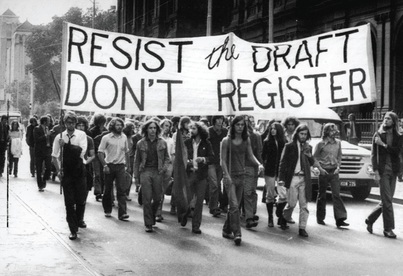
The Vietnam Antiwar Movement is famous for being the first mass movement using civil disobedience to protest a war in American history however, most do not understand that it was far more complex than many remember. The movement lasted for nearly ten years, evolving with the constantly changing circumstances, and can be broken down into four stages.

The first two groups arose in 1964-65 and consisted of the left-wing activists and college students. The activists opposed the Cold War and American intervention in foreign countries and most of the college students witnessed the southern civil rights movement and saw how the government had no problem ignoring injustice. These groups aimed to teach activists enough about Vietnam to be able to make others want to join the movement. Additionally, they wanted to normalize opposition since most were afraid to oppose the government.

During the second stage, those that were respected in the fields of politics, medicine, academics, entertainment, the press, and business began to announce their opposition to the war. They encouraged young men to resist the draft and to build opposition to help bring the war to an end. Influencers such as Muhammad Ali helped expand the opposition of the draft and thousands of young men were prepared to go to jail or face exile instead of going to war.

The third stage consisted of protests by antiwar veterans, one of the most memorable being when 800 men threw their combat medals over the fence surrounding the capitol. Yes, opposition to the Vietnam war was growing, but individuals were joining the movement in much smaller numbers. This is due to the fact that many were not willing to risk being arrested or getting injured.

The final stage developed tactics that attempted to construct a political force that would prevent Nixon's Vietnamization policy. Additionally, more antiwar organizations arose that did not require any major risks. These organizations and jobs along with antiwar candidates running for office gave the movement radio news outlets, documentary capabilities, and a news service. Law firms even began to defend the movement's work and networks of donors were created.

https://www.nytimes.com/2017/10/24/opinion/vietnam-antiwar-movement.html
https://peaceloveandbeyond.weebly.com/anti-war-movement.html

Sunday, February 9, 2020

The Reconstruction Era

Image result for the reconstruction era

After Abraham Lincoln issued the Emancipation Proclamation in 1863, large groups of African Americans, totaling nearly 180,000, had enlisted into the Union Army. Since the proclamation gave four million slaves their freedom, the South then had to begin to rebuild its economy and navigate new challenges.

Under Andrew Johnson's Presidential Reconstruction, all land that had been confiscated by the Union Army and distributed to the freed slaves was then returned to its prewar owners. Even though the southern states had to comply with the newly enforced 13th Amendment, their individual state governments were freely able to decide how to rebuild themselves. In response to this, in 1866 legislatures in the southern states passed the "black codes" which controlled the labor and behavior of African Americans, especially former slaves.  However, organizations such as the KKK eventually reversed these progressive changes and returned white supremacy to the South.

Later in 1866, the Republican Congress took over reconstruction in the South and in 1867 passed the Reconstruction Act. This act temporarily divided the South into five military districts and outlined how governments based on male universal sufferage were to be organized. The act also forced the South to ratify the 14th Amendment which extended the definition of citizenship to former slaves. Then in 1869, Congress approved the 15th Amendment which stated that a citizen's right to vote could not be denied on the grounds of race, color, or previous enslavement. By 1870, all former Confederate states were readmitted into the union, which led to the beginning of the end of the Reconstruction Era.

https://www.history.com/topics/american-civil-war/reconstruction
https://www.google.com/searchq=the+reconstruction+era&safe=active&rlz=1C1SQJL_enUS777US777&sxsrf=ALeKk03k0YNLMyApVELLnG0Gpjtom1lYA:1582243439496&source=lnms&tbm=isch&sa=X&ved=2ahUKEwiC7KKRrOHnAhVSknIEHWULCmYQ_AUoAXoECBcQAw&biw=1280&bih=578

Thursday, February 6, 2020

Roosevelt and the Court Packing Scandal

Image result for roosevelt's court packing scandal


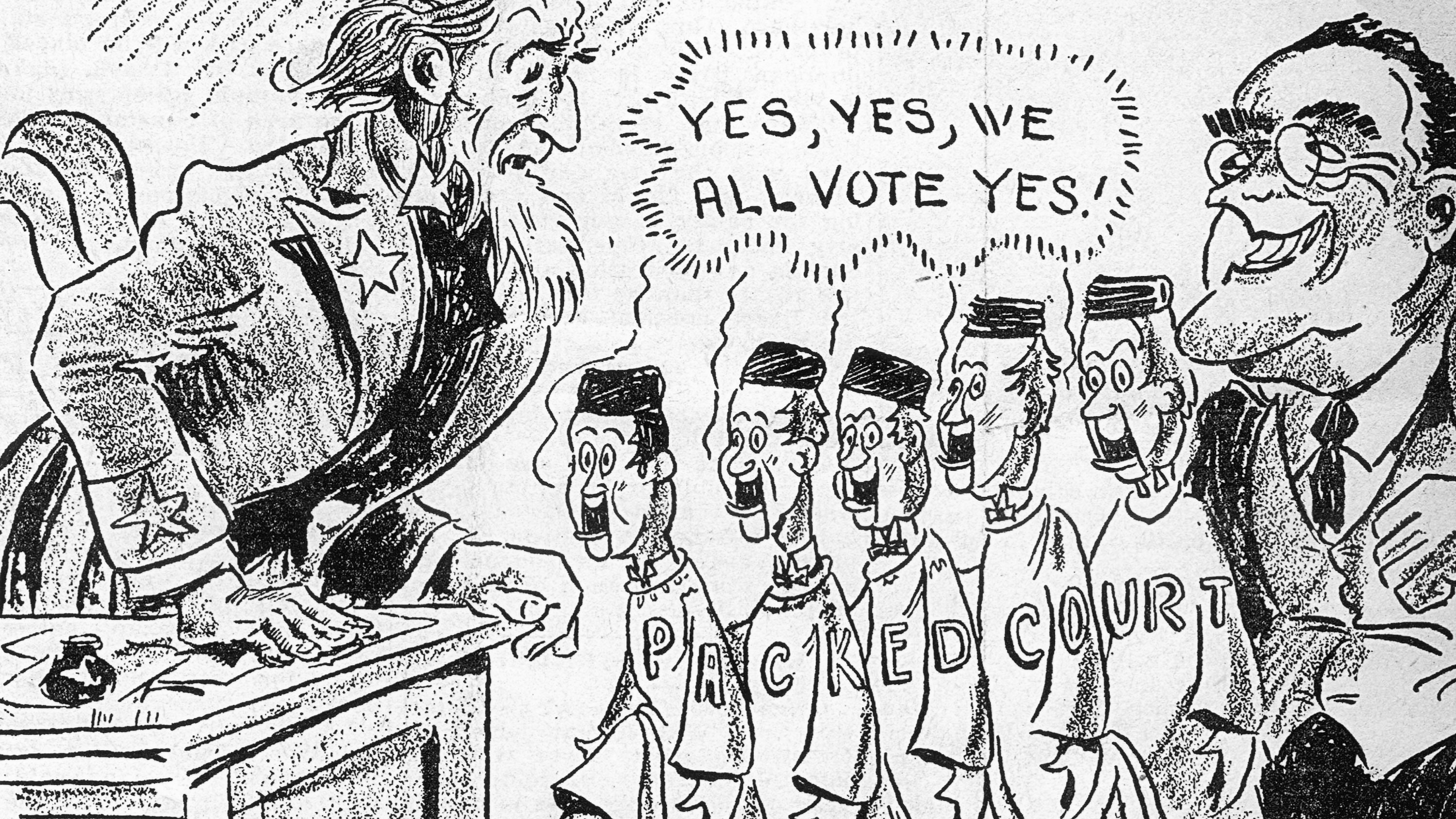
In February of 1937, Roosevelt proposed a bill that would appoint six new Supreme Court justices; one for each justice that was seventy or older that had yet to retire. Most saw this as Roosevelt trying tamper with the Supreme Court that had been vetoing his New Deal economic reforms. However, after Judge Clock underwent an investigation of the scandal, he came to the conclusion that Roosevelt's main goal was to get the older justices to retire, not to necessarily add additional seats for his personal gain. The Constitution laid how justices get put on the bench but never discussed how to remove them, and since their retirement salary was cut in half in 1932, most decided to devote their lives to the job and stay on as long as they possibly could. When the founding fathers were writing the Constitution, the whole "justice for life" thing was not an issue, but since life expectancy has gone up, justices stay a part of the Supreme Court until they are ready to depart.

In 1935, Roosevelt attempted to pass a bill that would restore the full retirement salaries but failed due to the budgetary concerns that arose during the Great Depression. This led to said court-packing scandal. However, Roosevelt's plan was modeled his plan after the 1860s Republican Congress' that also appointed new judges for each that would not retire and take their pension.

Personally, I do not see anything wrong with limiting the time justices can occupy a seat on the Supreme Court. The Constitution determined how long a president or congress member is in office, so why is it taboo to do the same thing for the Supreme court?

https://www.politico.com/magazine/story/2019/02/24/the-lost-history-of-fdrs-court-packing-scandal-225201
https://www.history.com/news/franklin-roosevelt-tried-packing-supreme-court

Thursday, January 23, 2020

Limitations on Contraception Coverage?


Image result for contraception
From the Obama administration came the Affordable Care Act which aims to make health insurance more affordable and available to a greater number people, expand the Medicaid program to cover all adults with an income below 138% of the federal poverty line, and create new and innovative medical care delivery methods that will help lower the costs of health care. Included in this act is a section that requires coverage for screenings for women and other preventive health services. In spite of this act, the Supreme Court is deciding whether the current administration can limit women's access to free birth control.


The act already did not apply to houses of worship such as churches and temples, but the Trump administration wanted to expand the exception to employers "with sincerely held moral convictions opposed to coverage of some or all contraceptive or sterilization methods". However, many individuals consider this an infringement of women's rights. Brigitte Amiri, who is a lawyer with the American Civil Liberties Union's Reproductive Freedom Project states that this new regulation "isn't religious liberty -- its discrimination".

I can see the arguments from both sides and the pros and cons associated with each. On one hand, it makes sense for employers to defend and practice their religious beliefs; after all, they are the business owner, therefore they make the decisions. In contrast, the employers would not be partaking in the use of contraception therefore how can they decide what other people can and cannot do? Additionally, a multitude of women cannot afford the expensive and most effective forms of birth control, so taking away free contraception could lead to an exponential increase in abortions, which what many conservatives are currently attempting to reduce.

https://www.nytimes.com/2020/01/17/us/supreme-court-contraception-coverage.html
https://www.healthcare.gov/glossary/affordable-care-act/
https://www.vectorstock.com/royalty-free-vector/contraception-day-control-icons-set-flat-style-vector-21579629


Introduction


My name is Hallie Daniel and I am from the small town known as Claremont, North Carolina. I am currently a junior majoring in psychology with a minor in philosophy. Over the summer, I found out that I was eligible to graduate a year early (this is my second year) due to all the college credits I received in high school. Taking on college classes during my junior and senior years of high school has been one of the smartest things I have done because it has saved me time and money, and put me on the fast track to pursuing my dreams.

In the fall of 2019, I joined the High Point University campus concierge team. Not only have I learned more about the university and the community of High Point, but I have learned more about myself as well. I am becoming more outgoing and confident when interacting with others due to the interpersonal skills that you must learn with the job.

This summer I will be taking the law school admissions test (LSAT) in hopes of getting into a law school in the Carolinas. Additionally, I am humbled because I have the opportunity to intern at a law firm in Hickory, NC starting in May. If everything goes according to plan, I hope to specialize in family law and to become a voice for the voiceless.